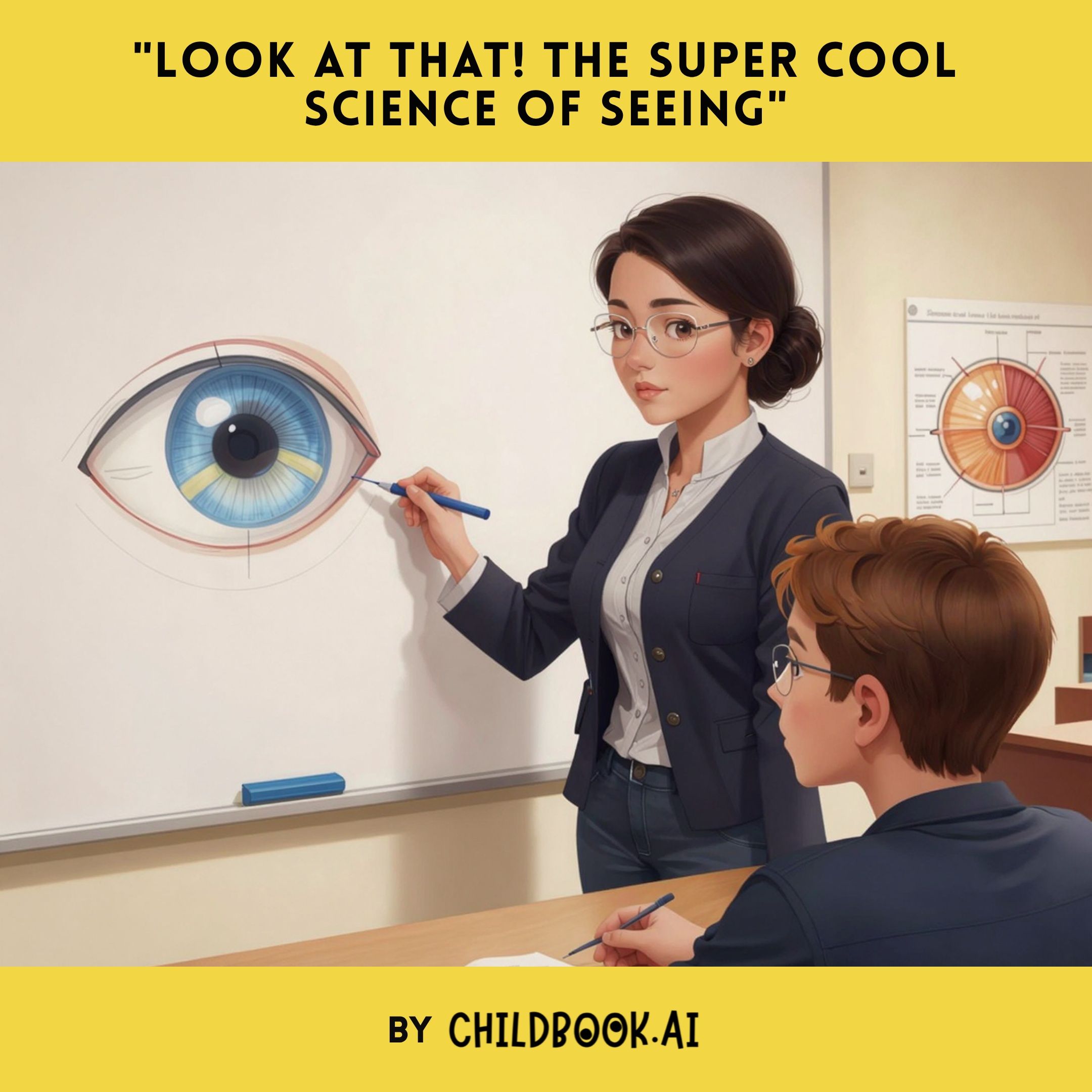

Johnny loved science class. Today his teacher said they would learn about eyes. "Our eyes are amazing," his teacher smiled. "They help us see everything around us." Johnny looked at his hands, then at the bright classroom. "How do my eyes work?" he wondered. His teacher pointed to a colorful poster. "Let's find out together! Get ready to discover the super cool science of seeing."

"Can anyone see in the dark?" the teacher asked. Johnny raised his hand. "A little bit!" The teacher nodded. "Your eyes can see very dim light. Imagine a tiny candle flame far, far away. Your eyes could still spot it!" She dimmed the classroom lights. "See how your eyes adjust? They're working hard to catch every bit of light. Your eyes notice even small changes in brightness. That's called your difference threshold!"

"Here are five fun facts," the teacher announced. Johnny leaned forward eagerly. "First, your eyes see about ten million different colors! Second, you blink fifteen to twenty times every minute. Third, your eye muscles are the most active muscles in your whole body!" Johnny blinked and felt his eyes move. "Fourth, you can spot a candle flame almost two miles away. Fifth, your eyes process thirty-six thousand pieces of information every hour!"

The teacher drew an eye on the board. "Let's learn the parts! The cornea is the clear front cover. The pupil is the black circle that lets light in. The iris is the colored part around your pupil." Johnny looked at his friend's brown eyes. "The lens focuses light like a camera. The retina is the back wall inside your eye. It has special cells called rods and cones that detect light and color!"

"The optic nerve is like a cable," the teacher continued. "It sends messages from your eye to your brain. Your brain does the real seeing!" Johnny touched near his eye gently. "And here's something funny. Every eye has a blind spot where the optic nerve connects. You don't notice it because your brain fills in the missing piece!" The class giggled. "Our brains are so clever," Johnny said.

"Now let's follow light on its journey," the teacher said excitedly. She held up a flashlight. "First, light bounces off everything around you. Then it enters your eye through the cornea, that clear front part." Johnny watched the beam. "The light passes through your pupil. In bright light, your pupil gets smaller. In dim light, it opens wider to let more light in. Pretty smart, right?"

"Next, light goes through the lens," the teacher explained. She used her hands to show the path. "The lens bends the light to focus it perfectly on your retina at the back of your eye." Johnny traced the path in the air with his finger. "The retina has millions of rods and cones. Rods help you see in dim light. Cones help you see colors and details in bright light!"

"When light hits the rods and cones, something amazing happens!" the teacher said. Johnny's eyes grew wide with wonder. "They turn the light into electrical signals. These signals zoom along the optic nerve like messages on a wire." The teacher tapped her head. "The signals travel all the way to the back of your brain. That special part is called the occipital lobe. It's your brain's vision center!"

"Here's the coolest part," the teacher whispered. The whole class listened closely. "Your eyes actually see everything upside down! But your amazing brain flips the image right side up." Johnny gasped. "Really?" His teacher nodded. "Your brain puts all the signals together and creates the picture you see. So you don't really see with your eyes. You see with your brain! Your eyes just collect the information."

The teacher handed out worksheets with strange pictures. "These are optical illusions," she explained. Johnny stared at his paper. "This picture looks like both a duck AND a rabbit!" His classmate pointed at another. "These lines look bent, but they're actually straight!" The teacher smiled. "Illusions trick your brain. They show that seeing isn't simple. Your brain works hard to make sense of what your eyes detect!"

"Everyone look at this spinning spiral," the teacher said, holding up a card. Johnny stared at it, then looked at the wall. "Whoa! The wall looks like it's moving!" Everyone laughed and tried it too. "That's called an afterimage," the teacher explained. "Your eyes and brain need time to adjust. What else do you see in these pictures?" Johnny loved how his eyes could be fooled in such fun ways.

"Now you know how seeing works!" the teacher said proudly. Johnny felt like a vision expert. "Your eyes and brain work together as an incredible team. They help you read, play, and explore your world." Johnny looked around the classroom with new appreciation. "Take care of your eyes. They're the only pair you'll ever have!" Johnny smiled. "Thanks, eyes!" he whispered. "You're super cool!" Everyone clapped and cheered together.