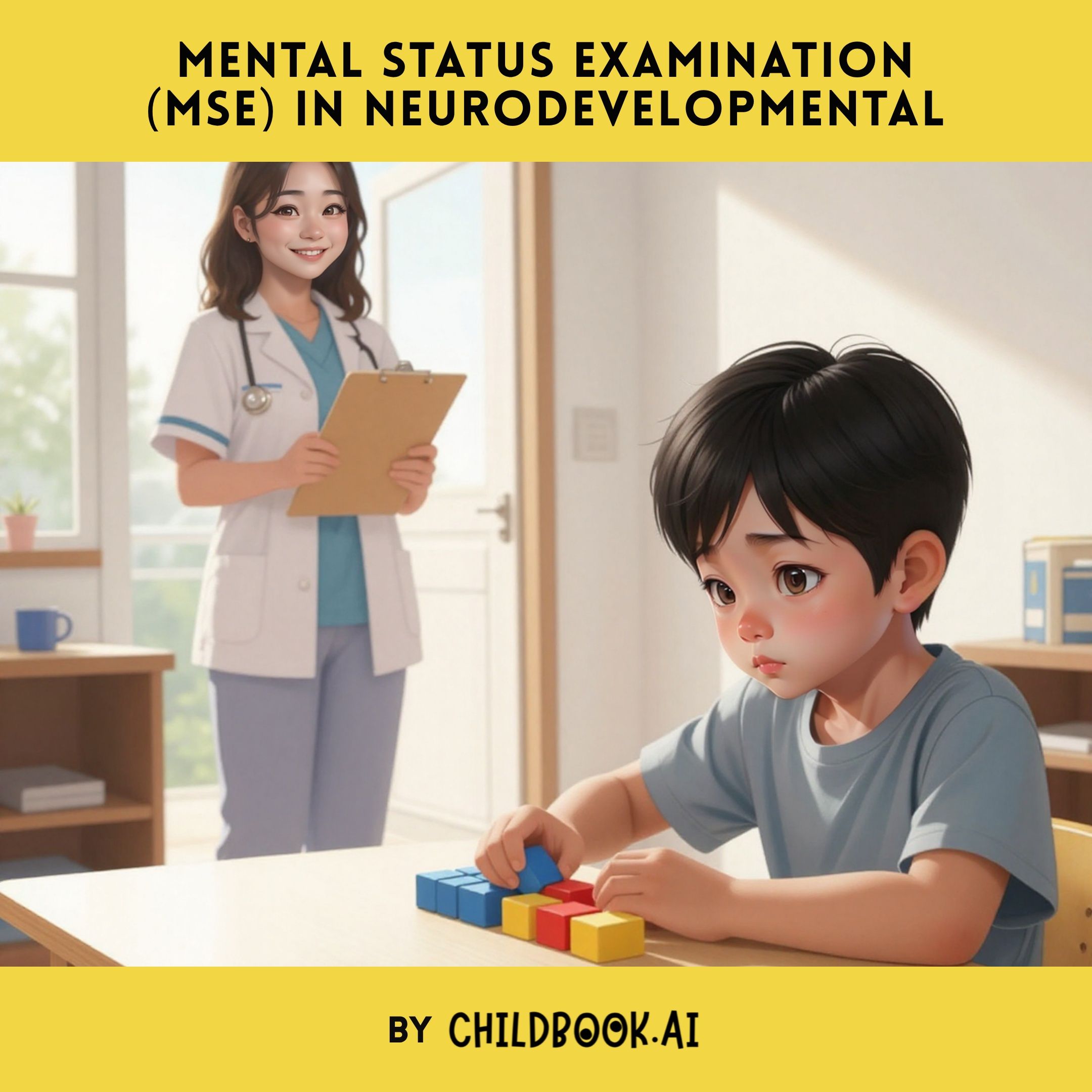

Nurse Maya entered the bright assessment room where ten-year-old Liam sat at a table, organizing colored blocks by size. His short black hair caught the morning light as he focused intently on his task. Maya smiled warmly and introduced herself, noting his preference for minimal eye contact. She observed his calm demeanor and precise movements, documenting these initial observations for the Mental Status Examination.

Maya sat down beside Liam, maintaining a respectful distance. "I see you like organizing those blocks," she said gently. Liam nodded slightly, continuing his arrangement. "Blue, then red, then yellow," he stated matter-of-factly. Maya appreciated his systematic approach and clear speech patterns. She noted his appropriate responses and emerging comfort in her presence, essential components of the MSE's behavioral observation section.

"Liam, can you tell me about your favorite subject at school?" Maya asked. He paused his block arrangement and replied, "Science. Specifically, the water cycle. Evaporation, condensation, precipitation, collection." His speech was clear and detailed, though his tone remained monotone. Maya observed his concrete thinking style and rich vocabulary. She documented his communication strengths and unique expressive patterns in the MSE framework.

Maya noticed Liam occasionally covered his ears when the air conditioning unit hummed. "Is that sound bothering you?" she asked. "It's too loud," Liam explained, his hands pressed firmly against his ears. Maya adjusted the thermostat, reducing the noise. Liam visibly relaxed, returning to his blocks. She noted his sensory sensitivities, an important aspect of the comprehensive MSE for neurodevelopmental assessment.

Maya introduced a simple collaborative game using the blocks. "Should we build a tower together?" she suggested. Liam hesitated, then agreed with a small nod. He placed blocks methodically while Maya added her contributions. "Your block goes there," Liam directed, pointing precisely. Maya smiled at his emerging engagement. Though his interaction style was unique, Liam demonstrated capacity for shared activities and communication.

"How are you feeling today, Liam?" Maya inquired gently. He paused, thinking carefully. "I feel... okay. Not worried. The blocks are nice." His facial expression remained relatively neutral despite his words. Maya recognized this as characteristic of autism—emotions present but expressed differently. She documented his self-awareness and ability to identify feelings, though outward expression was limited. Understanding this nuance was crucial for accurate MSE documentation.

Maya presented Liam with pattern completion tasks and memory exercises. He excelled at visual puzzles, quickly identifying missing pieces. "That one goes here because the pattern repeats," he explained logically. His attention to detail was remarkable. When asked to recall a list of items, he recited them perfectly in order. Maya noted his strong cognitive abilities, particularly in structured, predictable tasks requiring pattern recognition.

"Tell me about your morning routine, Liam," Maya requested. He brightened slightly. "Wake up at seven. Brush teeth for two minutes. Eat cereal with exactly ten blueberries. Check my backpack three times." His routine was precise and important to him. Maya understood that these structured patterns provided comfort and predictability. She documented his need for routine as part of the MSE's insight and judgment section.

"Are there things that feel difficult for you?" Maya asked compassionately. Liam thought carefully. "Loud cafeterias. When people talk too fast. When my schedule changes suddenly." His honest responses showed good self-awareness. Maya validated his experiences. "Those are real challenges, and it's important that people understand them." Liam nodded appreciatively. His insight into his own difficulties demonstrated meaningful self-understanding, valuable for treatment planning.

Maya shifted the conversation positively. "What are you really good at, Liam?" He looked up briefly. "Math problems. Remembering facts about planets. Drawing detailed maps." Pride was subtle in his voice. "Those are wonderful strengths," Maya affirmed. She noted his special interests and exceptional abilities in specific areas. Recognizing strengths was as crucial as identifying challenges in a comprehensive MSE for neurodevelopmental disorders.

Maya discussed helpful strategies with Liam. "What helps when things feel overwhelming?" she asked. "Quiet spaces. Deep breaths. Counting backwards from ten," Liam shared. Maya was impressed by his self-awareness and coping mechanisms. Together they discussed how teachers and family could support him better. Liam contributed ideas thoughtfully. Maya documented these insights, understanding that successful intervention builds on the individual's own understanding and preferences.

As the session concluded, Maya reviewed her MSE findings. Liam demonstrated clear strengths in cognition, memory, and self-awareness alongside characteristic autism features. "Thank you for sharing with me today, Liam," Maya said warmly. "You helped me understand you better." Liam offered a small smile. "Will you tell my teachers about the loud cafeteria?" he asked hopefully. "Absolutely," Maya promised. Her comprehensive MSE would guide meaningful support for Liam's journey.
--:--
--:--
0/12