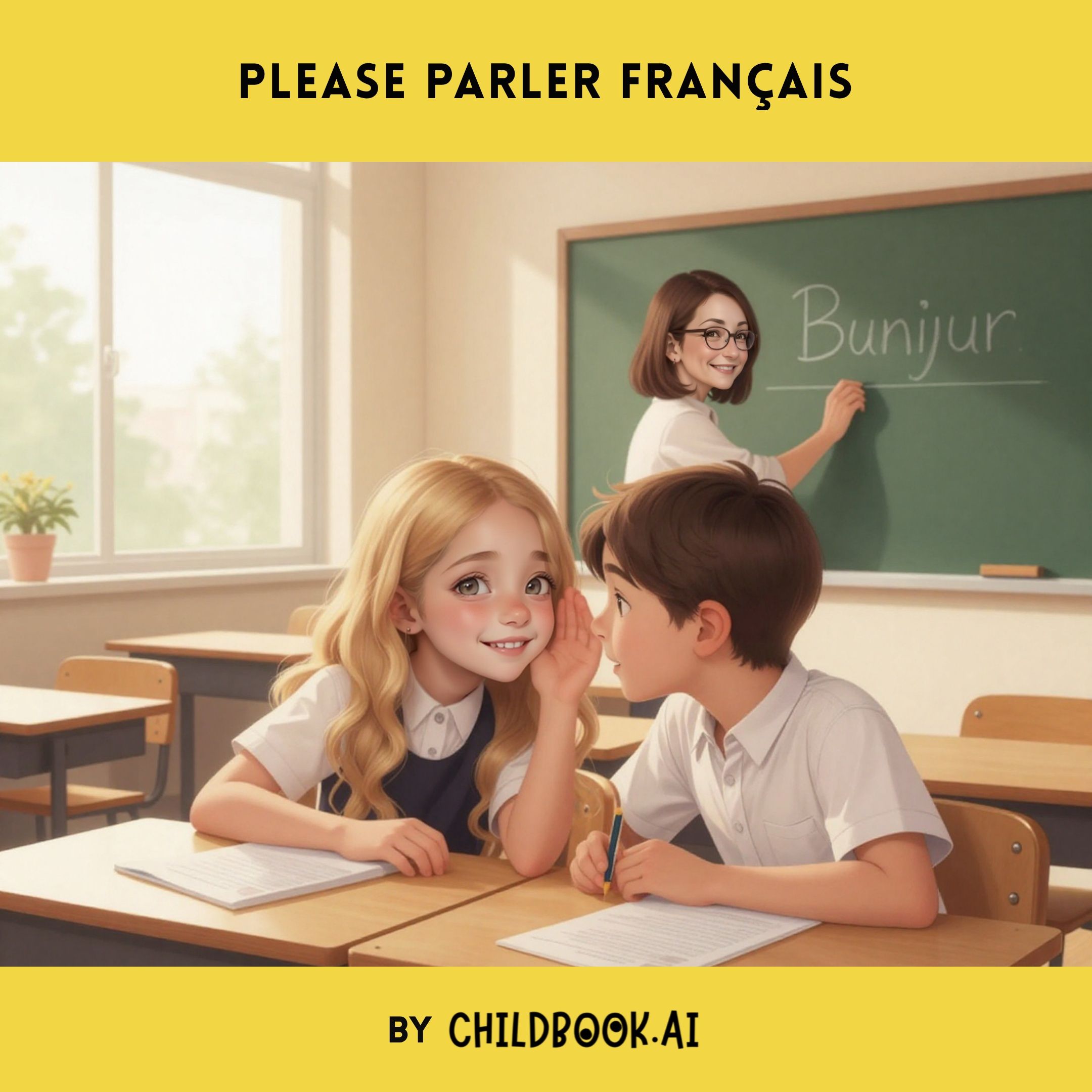

In Grade 6, I walked into French class for the first time. The teacher wrote 'Bonjour' on the board. 'Bonjour classe! Aujourd'hui, nous allons apprendre le français,' she announced. My friend Mia whispered, 'Do you understand what she just said?' I whispered back, 'I think bon-jur means hello?' Mia asked, 'Why do we even need French?' I shrugged. 'Maybe if we go to France one day?' Learning French felt strange and new, but also kind of interesting.

Our teacher led us through repetition exercises. 'Repeat after me. Je suis,' she said. 'Je suis,' we all echoed. 'Tu es,' she continued. 'Tu es,' we repeated. She went faster. 'Il est!' 'Il est,' we said tiredly. I quietly asked Ailie, 'If I say je suis tired, does that count?' Ailie giggled. 'I don't think she'd notice.' The teacher looked up with a stern face. We quickly went back to repeating French words properly.

My desk was covered with French worksheets. I filled in blanks with je, tu, il, and elle. Some worksheets had pictures of cats and dogs with French labels. Mia sat next to me, chewing her pencil. 'This is worksheet number five today,' she sighed. I nodded. The worksheets helped me learn, but they felt like homework mountains. Still, I was starting to recognize patterns. French was slowly making more sense to me, one worksheet at a time.

The teacher announced dictée time. Everyone groaned. She read quickly, 'Les enfants jouent dans le jardin pendant que leur mère prépare le dîner.' I frantically scribbled words. 'Wait, what was that word?' I whispered. After dictée, Ailie and I compared papers. 'What did you get for the last word?' she asked. 'Uh, dîner,' I said. Ailie laughed. 'I wrote dino!' We giggled. Dictées were hard, but at least we could laugh about our mistakes together.

Today we learned French colors and numbers. 'Rouge, bleu, vert, jaune,' the teacher pointed at colorful posters. We counted, 'Un, deux, trois, quatre, cinq!' Mia mixed up sept and seize. I confused dix and douze. The teacher made us play a color game. 'Touch something bleu!' she called. We raced around touching blue things. Learning through games was way more fun than worksheets. By the end, I could name ten colors in French!

The teacher played a French song. 'Frère Jacques, Frère Jacques, dormez-vous?' We sang along, even though we didn't understand everything. Ailie made funny faces while singing. I tried not to laugh. The melody was catchy and stuck in my head all day. At lunch, Mia and I sang it again. Other kids joined in. Soon the whole cafeteria was singing French! Music made French feel less scary. It felt like fun instead of homework.

Our teacher announced a vocabulary challenge. We'd learn ten new words each week. I made flashcards with French on one side, English on the other. Mia quizzed me during recess. 'What's pomme?' she asked. 'Apple!' I answered correctly. We practiced everyday objects: chaise, table, livre, stylo. Ailie created silly sentences to help us remember. 'The purple pomme danced on the chaise!' We laughed but it worked. By Friday, I knew all ten words perfectly!

The teacher showed us a French cartoon movie with subtitles. Characters spoke quickly, but I caught familiar words: bonjour, merci, au revoir. The story was about a boy and his dog. Mia pointed at the screen when she recognized words. 'I heard école!' she whispered excitedly. I spotted maison and chat. Even though I couldn't understand everything, following the story felt like an accomplishment. French wasn't just classroom exercises anymore. It was a real language people used!

Our class celebrated French culture day. We brought French food to share. Mia brought croissants. Ailie brought cheese. I brought baguette pieces. The teacher taught us about Paris, the Eiffel Tower, and French artists. We looked at pictures of beautiful French cities. 'I want to visit France someday,' Ailie said dreamily. 'Me too,' I agreed. Learning about French culture made the language feel more real. It wasn't just grammar rules. It was about people and places.

The teacher paired us up for conversation practice. I practiced with Mia. 'Comment ça va?' I asked nervously. 'Ça va bien, merci,' Mia replied proudly. We asked each other about favorites: favorite colors, animals, foods. At first, we spoke slowly and made mistakes. But we kept trying. 'Your pronunciation is getting better!' Mia encouraged me. I smiled. Speaking French out loud was scary, but also exciting. My confidence was growing with each conversation.

Conjugating verbs used to confuse me completely. But now patterns started clicking. Je parle, tu parles, il parle. I finally understood the rules! Ailie and I practiced together after school. 'You're really getting good at this,' she said. I felt proud. All those repetition exercises and worksheets were paying off. French grammar wasn't impossible after all. It just took time and practice. I realized learning a language was like solving a puzzle, piece by piece.

At the end of Grade 6, I reflected on my French journey. I went from not understanding anything to recognizing words, sentences, and patterns. Mia and Ailie made learning fun. We laughed at mistakes and celebrated small victories. French still challenged me, but I wasn't afraid anymore. I looked forward to learning more next year. Maybe one day I'd visit France and use my French for real. 'Au revoir, Grade 6,' I said with a smile. My French adventure was just beginning!